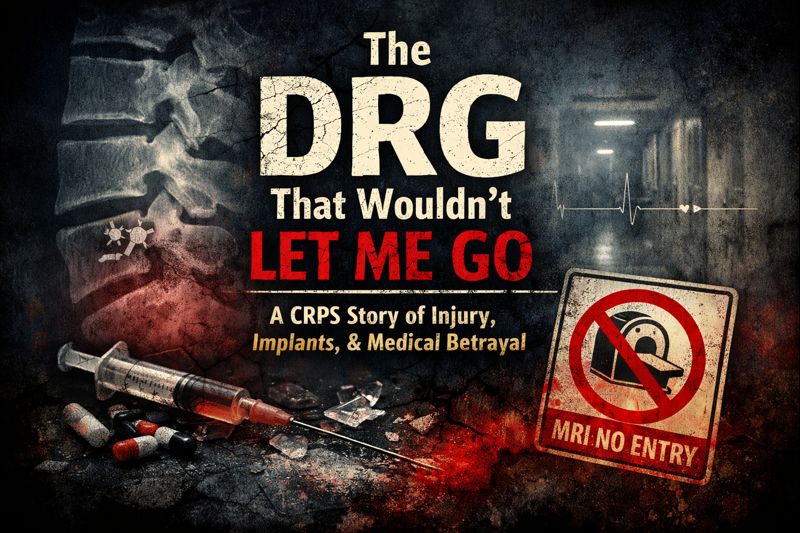
A CRPS story about injury, disbelief, implanted hope, and the cost of not being listened to.
This post contains discussion of medical trauma, surgical complications, chronic pain, CRPS, medical gaslighting, coercion within healthcare, seizures, loss of mobility, ableism, grief, and death of a loved one. It also includes descriptions of injury, hospitalization, and invasive medical procedures.
Please take care of yourself while reading. You are encouraged to pause, skim, step away, or return later if your nervous system needs gentleness. You are not required to read this all at once, or at all.
Welcome Back to the Cryptid’s Den
Welcome back to The Crippled Cryptid, where disability, chronic illness, service dogs, and everyday sorcery all gather under the same soft lamp like friendly ghosts trading stories.
This post has been brewing since CRPS Awareness Month. I knew I would tell this story eventually.
The whole story.
Not the sanitized version.
Not the “everything worked out” version.
The real one.
It’s long.
It’s personal.
And frustratingly, it isn’t over yet.
If you’re new here: hi, I’m Sky.
Professional cryptid.
Unwilling amateur cyborg.
Medically interesting enough to make half my providers sigh when they open my chart. (Truthfully- I sigh too.)
I live in a haunted meat-suit with a questionable warranty.
If you’re returning: welcome home.
If you’re new here:
Welcome to the Lunatic Café. On today’s menu, medical gaslighting, trauma dumping, and lots of coffee. (Please don’t tell the neurologist, or the service dog I’m still on seizure watch.)
Before we go any further, a note of care. This post discusses medical trauma, chronic pain, and repeated healthcare failures. If your nervous system needs gentleness today, please listen to it.
Some stories begin with a diagnosis.
Mine began with a rag on the stairs.
CRPS Timeline Context:
When I was later diagnosed with CRPS, I was explicitly told about the so‑called “CRPS timeline.” About how early intervention matters. About how untreated or poorly managed CRPS carries an increased risk of severe depression and suicidality. About how many patients are warned they have one to three years before the condition becomes significantly harder to control. That clock started ticking the day I fell.
This timeline matters. It frames every delay, every dismissal, and every decision that followed.
Timeline: August 21–22, 2020
My grandmother left it there carelessly.
This was not new behavior. For years- my entire life up to that point- we had begged her not to throw rags and clothes down the stairs. Awful, brown, carpet covered things with twists and turns where things could be lost out of sight- even if you thought you were looking hard enough for them. My mother had fallen that way. My younger brother had fallen that way. I had fallen that way before.
I don’t believe in speaking ill of the dead, but I do believe in accountability.
If she had not continued to throw things down the stairs after years of warnings, I would not have fallen that day. This was the fall that changed everything. Even though I was looking- I always did, I didn’t see the wet rag there until I felt it underneath my foot.
I stepped on it.
I fell.
The sound wasn’t cinematic. Just a dull shift in the air. My foot twisted wrong. My body made a noise that wasn’t a scream or a groan but something closer to disbelief.
I made it to the bottom of the stairs in the blink of an eye- what felt like flying- and sat there stunned. Silent. Then I called for help. And then I cried.
I don’t cry when I’m hurt. I laugh. Always have. Autism, ADHD, gallows humor, pick your poison. But when M&M saw me sitting there like a broken doll and I said, “I think I have to go to the hospital,” I think we both knew something was wrong.
I knew immediately something was wrong.
The pain wasn’t normal pain. It wasn’t the sharp flash of a sprain or the ache of a bruise. It was deep, electric, wrong. M&M- my partner, my best friend, the Moss Maiden- drove me to the ER that first night on August 21, 2020. My grandmother didn’t want to take me, made up some half assed excuse. My younger brother was too young to drive. The responsibility fell on her, the person who has stood beside me through every chapter of this. I write about her often.
I couldn’t put weight on my foot, and instinctively, I knew this wasn’t something to walk off.
They told me two conflicting stories alone in the ER- they wouldn’t let M&M come with me, still in the height of Covid, she needed to sit in the car.
First, it was a sprain.
Then, it was a hairline fracture.
Either way, I went home on crutches, with a flimsy air cast and instructions to rest, ice, elevate, and trust the process. I tried to trust the doctors.
That was my first mistake.
The Misdiagnosis Cascade
Timeline: September 2020
A month passed. The pain never improved. Bruising lingered. New symptoms bloomed.
I went to the follow up appointment with my GP and tried to bring up my concerns- ones that he just brushed off, saying that maybe I was just “sad.” Maybe it was depression.
My mother had died, losing her years long battle with lung cancer in March of 2020- and somehow he thought that my symptoms, and concerns could be connected.
Grief can do many things but, it cannot convince your body that it is on fire.
It cannot make nerves behave like a bonfire.
When Pain Doesn’t Behave
Timeline: October 2020
The swelling didn’t go down. The color of my foot changed. Sometimes it burned. Sometimes it felt submerged in ice water. Sometimes it felt like my bones were vibrating. My foot became something I couldn’t recognize as my own.
I went back to the ER… eventually.
That second trip was in October. My brother, Matthew drove me one night late after work, after watching me fold in on myself, no longer the same person. Eaten by the pain I was learning how to live beside like an unwanted houseguest. I was still trying to be a “good patient.” Still trying to believe that if I followed instructions closely enough, my body would cooperate.
This was when a referral for orthopedics was prescribed- from there it was physical therapy. This was when I met the podiatrist who would become the first person to say four words no one else had said yet:
Complex Regional Pain Syndrome.
She also noted how hypermobile I was. How far my joints moved past where they should stop. She gently suggested that I might want to look into Ehlers-Danlos Syndrome.
No one had ever said that to me before.
Sometimes the right diagnosis arrives as a whisper, not a proclamation.
(It took two more years- until 2022 to get my EDS diagnosis. I wish I could thank her for all of her help and good advice.)
Physical Therapy: Help, Harm, and the Space Between
PT was not universally bad. Some therapists listened, believed me, and helped me learn safer ways to move my body without triggering massive flares. Those moments mattered.
But other sessions caused measurable harm.
CRPS does not respond well to being pushed through pain. My nervous system was already in overdrive, and repeated insistence that I override warning signals made the condition worse. When I flared, it was framed as fear. When I couldn’t complete exercises, it was framed as noncompliance.
This was medical gaslighting in real time: being told that worsening symptoms meant I wasn’t trying hard enough, not that the treatment itself was inappropriate.
When pain is treated as a character flaw, treatment becomes punishment.
PT was prescribed quickly. And here’s the truth that deserves nuance.
Physical therapy can be lifesaving. For many people, it is.
For me, it was complicated.
My therapists were not monsters. They believed in recovery. They believed effort equals improvement.
But CRPS does not obey effort.
Sessions were brutal. My nervous system screamed while my body failed in public. Encouragement turned into frustration. Frustration turned into implication.
I was trying.
I was not lazy.
Pain that worsens with use is not moral failure.
“PT didn’t empower me. It humiliated me.”
That matters, because rehabilitation that strips dignity becomes another trauma the body has to store. Trauma that I’m still living with five years later, at the time of writing this post.
Sympathetic Nerve Blocks and the First Taste of Relief
Timeline marker: Late October 2020
When PT failed, I was referred to pain management.
CRPS loomed.
Medications failed spectacularly. Side effects piled up. Nerve blocks offered brief quiet followed by days of nausea, anesthesia hangovers, and disappointment.
They did not fix me.
They did teach me how small my world could become.
My first sympathetic nerve block was in late November.
For the first time in months, the pain softened just a little. Just for a few hours.
It wasn’t gone. But it was quieter. The burning dulled. The ice-water sensation receded. I could breathe again.
That relief was temporary. But it was proof.
Proof that the pain wasn’t imagined.
Proof that my nervous system was misfiring.
Proof that there was a medical explanation, even if we didn’t fully understand it yet.
More blocks followed. Each came with hope. Each came with diminishing returns.
That’s when the word DRG entered the room.
I was a paper tape mummy in a hospital shaped sarcophagus.
The DRG Trial: Hope, Carefully Implanted
Timeline: 2021
After extensive testing, CRPS was confirmed.
The doctor called it “the suicide disease.” He quoted statistics. Told me how long people last without intervention.
Then he offered hope.
A DRG trial.
Dorsal Root Ganglion stimulation was presented as targeted. Advanced. Especially effective for CRPS.
I did my homework. I asked questions. I was scared.
The trial was questionable. -I spent 3-days sedated with benadryl and painkillers being told that it worked. Three days, where I hardly moved from my bed, nauseated, dizzy, and miserable.
But the pain was less. (Perhaps from the pain medication or sedation, I’m not sure.)
I don’t want to erase that fact.
The pain reduction was real. I walked more. I slept better. For the first time since the fall, my body felt like it might be willing to negotiate.
That success is what makes this story complicated.
Because DRGs can help people. They still do.
Something can be effective and still dangerous when done wrong.
My family and the doctor were pushing for me to go ahead with the full implant, and when I read the risks, found out that I could no longer have MRIs- something that I need with my migraine conditions I was skeptical and unsure… but I wanted to make them happy. I wanted to feel better, and I wanted to hold onto that same hope that the doctor had.
Medical Context
DRG stimulation can help some people. Especially those with localized neuropathic pain. For some, it is life‑changing.
It was sold to me as a miracle cure.
When hope is scarce, miracles sound reasonable.
The trial blurred together in medication fog. My family encouraged me to continue.
M&M hesitated.
I wish we had listened harder.
Even from afar at the time, M&M was telling me that she had a bad feeling. I wish that we’d all listened to her.
Implantation, Revision, and the Slow Turn
Timeline marker: 2021–2023
The implant came with promises.
Instead, it brought complications.
My regrets were instantaneous.
Healing was a process, one that came with frequent bandage changes- blood in my sheets, and endless hours spent in my own vomit and tears. Infection was a real problem, one that I couldn’t prevent. (And not only from my workplace disrespecting and disregarding my boundaries at the time.)
Lead migration. Poor healing. Endless reprogramming. Revisions. And then, in 2023, the battery overheated violently while my family watched my back glow red like a stove coil.
“Relief always felt a breath away and a lifetime out of reach.”
I was told to wait. Try again. Give it more time.
When I pushed back, the answer became a permanent pain pump.
At 27.
The doctor said I would never again go in a bath, a swimming pool, on planes, or on roller coasters. He made it sound like I would be bedbound.
At 27.
I said no.
And I left.
I began to feel like my body was becoming a construction site no one was supervising.
Removal Isn’t Always the End
Timeline marker: March 11, 2024
I found a new pain management doctor- closer to home.
One that I thought I could trust who seemed to know what he was doing, and who seemed to understand my frustrations.
The DRG was no longer functional. Abbott confirmed it. Removal was scheduled.
I believed this would be the end.
It wasn’t.
Lead fragments remained.
I would not learn that until nearly twenty months later.
“Finding out pieces remained felt like being betrayed by a ghost I thought I’d buried.”
MRIs remain unsafe. Pain escalated. And pressure to try SCS followed.
The answer is no.
Last week, I learned that lead tips were left behind in my L5–S1.
Platinum-iridium fragments.
Permanent.
Still inside me.
“Fully removed” turned out to be an approximation.
The MRI Wall and the Seizures That Followed
In December of 2025, my body added a new layer to the story.
An unwanted one.
My first seizure happened on December 2nd.
The second came on December 12th.
I am now on anti-seizure medication.
My doctors want answers. Neurology wants imaging. Cardiology is involved now too. I’ve since had a cardiology visit and am scheduled for an echocardiogram, a PET scan, a five-day heart monitor, and follow-up appointments between now and March.
The problem is simple and devastating.
I cannot safely have an MRI.
Because of what was left behind.
This is something every person considering a DRG or an SCS needs to understand:
You are trading future diagnostic access for present pain relief.
If everything goes perfectly, maybe that trade works.
If it doesn’t, you may find yourself locked out of lifesaving diagnostics.
Medical Gaslighting and Coercion: Red Flags
I was told by an RN I’ve written about before to lie to MRI staff.
More than once.
To say the device was removed.
To say it didn’t even exist at times, if that was what it took to get me into MRI.
To not complicate things.
That advice could have killed me.
It could have injured MRI staff.
And it speaks to a larger problem:
- Being pressured to minimize risks
- Being told complications are “rare” instead of discussed honestly
- Being treated as difficult for asking questions
- Being encouraged to lie instead of being protected
If a provider asks you to lie, leave.
Luna and the Coping Era
On May 11th, 2024, we brought Luna home as a pet.
She started alerting on her own.
Migraines. Seizures. Changes in my body before I could name them.
That’s how her service dog journey began.
Not because I planned it.
But because my life demanded adaptation.
Coping, I’ve learned, is not surrender.
It’s architecture.
Mobility aids.
Adjusted expectations.
Psychological triage.
Learning which battles are worth fighting on which days.
The Ongoing Chapter: Seizures, Cardiology, and What Comes Next
Timeline: Late 2025
Cardiology was surprising… I didn’t get brushed off the way that I thought I would. I’m used to it, everyone sees me as “young and fine” until I’m not. And we’ve built up quite the roser.
Upcoming: • PET scan • Echocardiogram • 5‑day monitor • Follow‑up
A laminectomy consult looms in the distant horizon in January.
Neurology also has it’s hands in the pot with a 3-day EEG of my brain, wires, goop in my hair, the works. We’re looking for seizure activity to figure out what this is and why it keeps happening- especially since I can’t have the MRI that the neurologist wants.
My life is appointment cards instead of memories with my family around the holidays.
Something that’s very important to me- especially with this being our first Christmas without Bear.
Something I’m still not over.
And I’m still here.
What I Wish People Knew
- I wish people knew CRPS is not “just pain.”
- I wish that people knew that doctors don’t know everything.
- I wish people knew DRGs and SCS devices are not reversible decisions in the way they’re often framed.
- I wish people knew that being a compliant patient does not protect you from harm.
- And I wish people understood that telling stories like this isn’t bitterness- it’s advocacy. It’s passing down our lived experience, in the way that our (or at least my Native ancestors did) before us.
- It’s prevention.
- It’s knowledge for the next generation- because you should always be doing research before a big surgery, and trying to get as much information as you can from others who have gone through the same thing.
- I also wish that I had known more about EDS at the time of having this done, so that I could’ve asked more questions about how my Ehlers-Danlos syndrome was going to change the results of this process: healing, the way the DRG works inside of my body, and what the risks for it would entail.
A Reader-Friendly Timeline
- Fall: Injury from fall on stairs, misdiagnosed as sprain
- September: Second ER visit, PT prescribed, CRPS and hypermobility first mentioned
- Late October: First sympathetic nerve block
- Following months: Additional blocks, DRG trial
- Implantation: Permanent DRG placed
- Revision: Due to complications
- March 11, 2024: DRG removal, later found to be incomplete
- May 11, 2024: Luna comes home, begins alerting
- December 2 & 12, 2025: Seizures begin
- Present: Awaiting neurosurgical follow-up, restricted from MRI
Questions to Ask Before DRG or SCS
- What happens if removal is incomplete?
- What imaging will I lose access to?
- Who is responsible for follow-up if something goes wrong?
- How are complications documented and disclosed?
- What happens if I lose trust in this care team?
Final Notes
This is my story.
It is also a warning label.
I am not anti-technology.
I am anti-neglect.
And I am done being quiet.
Written from the heart with coffee on one side, from inside of my Nightmare Before Christmas onesie, and Luna snoring on the bed like a mini jet engine.
© The Crippled Cryptid- Disability, honesty, and a little chaos. https://linktr.ee/skylanarissa
There is absolutely zero pressure to donate, but sharing or reading means the world to us. Support Sky’s Journey to Health and Mobility https://www.gofundme.com/f/support-skys-journey-to-health-and-mobility


Leave a comment