Trigger Warning / Content Note: This post discusses discrimination, ableism, racism, food insecurity, and challenges faced by disabled people and service dog teams.
Welcome back to The Crippled Cryptid, where disability, chronic illness, service dogs, and everyday sorcery gather under the same soft lamp like friendly ghosts trading stories.
If you’re new here: hi, I’m Sky.
Professional cryptid.
Unwilling amateur cyborg.
Medically interesting enough to make half my providers sigh when they open my chart. Truthfully, I sigh too.
I live in a haunted meat-suit with a highly questionable, out-of-date warranty.
If you’re returning: welcome home.
On today’s menu at the Lunatic Café: discrimination.
Before we get started, I want to say this plainly.
This is not an easy topic. It’s uncomfortable. It’s heavy. And it’s one many people would rather avoid. But it’s also important, because these experiences don’t happen in isolation, and silence doesn’t protect the people most affected by them.
The Incident
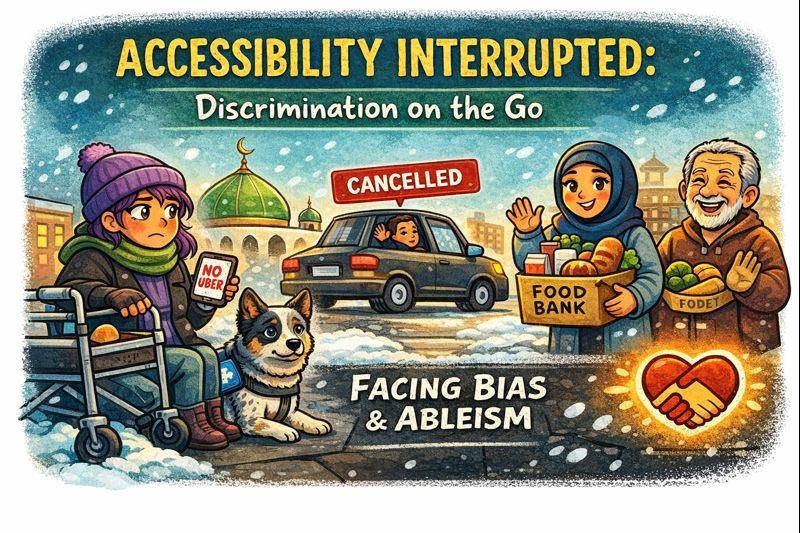
This isn’t the first time I’ve encountered ableism. I’ve written before about Uber drivers refusing to pick you up if you have a service dog, or if you use bulky, visible mobility aids like my cane or rollator walker. Lately, since my seizures began, M&M suggested we start taking the walker out with us more. Something I initially, and still, don’t want to do. Not because I don’t need it, but because accessibility in the real world is often an illusion.
But this time, we encountered a type of discrimination I didn’t expect.
Our family has been using a food bank run out of an interfaith halal food pantry located on the grounds of an Islamic temple for several months now. This was a necessary change after our previous food bank moved locations and became less accessible due to the days and times of my medical appointments.
For people like me, the food bank is sometimes one of the only reasons I get to leave my house during the week that isn’t a doctor’s appointment. It’s not just about food. It’s about being part of the world. Even being able to bring some of our friends homemade Christmas cookies that we put real effort into making mattered to me.
Did I have the Service Dingo breathing down my neck like a tiny cryptid warrior the entire time? Yes. Absolutely. But it was worth it.
Because sometimes community matters more than bias, religion, and other people’s half-baked prejudices.
After finishing at the food bank, we tried to order an Uber. For nearly an hour in the brutal Illinois cold, no rides would show up. At first, I assumed it was the weather or the timing. It was a cold Saturday right before Christmas. People were out shopping. There should have been drivers everywhere.
Ironically, according to Uber there were “plenty of drivers in our area.” Still, crickets.
Eventually, we learned the reason: location.
When we finally managed to get a ride, the driver admitted that some drivers refuse rides based on where they’re being picked up. She explicitly stated that she didn’t want to go there until she saw my name and realized that most Islamic people aren’t named Sky.
But it isn’t. If you want to get oddly specific, it’s Skyla. It’s Greek, and I use it for almost nothing.
About Racism and Whose Burden This Is
I want to be very clear here.
I am not Muslim. I am not Islamic. These are not forms of discrimination I face every day. I am white-presenting despite having Native ancestry, and that affords me a level of safety and invisibility that others do not have.
Especially in America. Especially today.
But racism doesn’t have to be aimed directly at your body to be real.
Discrimination based on location, religion, and assumed identity is still racism. It still causes harm. It still affects access to resources, safety, and dignity. And it affects the people who rely on this food pantry far more often, and far more harshly, than it affected me.
I’m choosing not to name the exact location of the pantry, not out of avoidance, but out of care. Because bigotry doesn’t need help finding targets.
What happened wasn’t a misunderstanding. It was bias. And bias like this doesn’t exist in a vacuum.
Reflection on Prejudice
Do you think it’s right for people to let their racism, religious prejudice, or general bias get in the way of doing their job? To be this open about it?
With Uber, passengers don’t get a choice in how pickup locations appear. I don’t input an address that hides context. The app shows the name of the place that owns the land or the building I’m being picked up in front of. I don’t choose that. And just because a food pantry is run by an Islamic organization doesn’t make it bad or dangerous.
Every week we go, we leave with beef, chicken, canned goods, milk, fresh produce, and sometimes eggs or butter if we’re lucky. Local bakeries donate sweets. Volunteers ask about our lives. We ask about theirs. We’ve made friends here who genuinely care about us and our well-being.
No one preaches to us. No one tries to convert us. No one treats us like a problem.
This is what community looks like.
And yet, someone’s prejudice meant we were left waiting in the cold, unsure how we were getting home.
✦ What made this hurt even more was what happened next.
Once the driver realized we weren’t going to the Islamic temple itself, but to a food bank, her tone changed. She began asking what kinds of food we received. She commented on how good it must be to go there. She asked if you needed ID, if you had to be part of the temple, if you needed to participate in the religion.
We were honest. Because we aren’t the kind of people who are going to gatekeep a precious resource if someone is truly in need.
We told her the requirements were simple: sign up with the Northern Illinois Food Bank and show up on the days the pantry is running. That’s it. No strings attached.
But it didn’t sit right with me.
Up until that point, she had been putting these people down. People who have been helping my family for months. People I see every week. People who ask how we are, ask about Luna, ask about our holidays, and quietly set items aside because they know our likes and dislikes.
That, too, is racism.
Hating someone until you see what they can do for you.
And only for you.
This kind of blatant racism hurts everyone. It hurts our friends at the food bank. It hurts the people who rely on it. It hurts everyday people who are already struggling because of their religion, the color of their skin, or the way they look. And it is wrong.
It reminded me of Emancipation, the movie M&M and I recently watched. It reminded me how much America hasn’t changed. There are still good people here, if you know where to look. And there are still far too many who haven’t learned a thing.
At one point, I told M&M that if another Uber canceled on us, I was going to start walking home. Was that wise in a fracture boot, using a wheelchair, with bags of groceries? No. But it was 2 p.m., the sun sets around 4 p.m. in Illinois winter, and I felt like we were burning daylight and running out of viable options.
I didn’t say it out loud, but I was cold. And I was scared that we were stranded.
That fear lit a fire in me about just how badly we need another vehicle.
Ableism, Service Dogs, and the ADA
This is the part many people don’t know.
In the United States, service dogs are protected under the Americans with Disabilities Act. They are not pets. They are medical equipment. Ride services like Uber, Lyft, and taxis are legally required to transport disabled passengers with service dogs.
Drivers cannot refuse service because of allergies, fear of dogs, or personal discomfort. They cannot require you to use Uber Pet. They cannot charge extra fees. Refusing a ride because of a service dog is discrimination.
And the harm isn’t theoretical.
Since losing our car in October after another driver hit us and totaled it, I haven’t been able to bring Luna everywhere like I should. Luna is a task-trained medical alert service dog. She can detect migraines, dizziness, seizures, and muscle spasms before they happen.
If I had Luna with me on December 2nd before my first seizure, she may have been able to help me get to the ground safely. It wouldn’t have prevented the seizure, but it could have prevented the concussion that resulted from it.
Being denied transportation because of a service dog isn’t an inconvenience. It’s a medical risk.
Accountability and the Illusion of Reporting
Uber provides a way to report discrimination. In my experience, the outcome is almost always the same: a generic apology, no refund, no transparency, and no assurance that the behavior won’t continue.
Yesterday alone, nearly $55 was spent attempting to get home. Money covered by Uber gift cards my aunt sends to help us survive this period without a car. Money drivers still expect tips on. Money Uber keeps.
And the drivers who engage in racism, harassment, or discrimination continue operating as the face of the company.
An apology without accountability isn’t resolution. It’s damage control.
There should be meaningful consequences for drivers who engage in racism, sexual harassment, or discrimination while representing a service disabled people are forced to rely on.
Food Insecurity, Instacart, and “Choice”
This doesn’t stop with Uber.
Without this food pantry, there are nights I worry my fridge and pantry would go bare. Food stamps only stretch so far, even with couponing. And when you rely on delivery services like Instacart, you are at the mercy of drivers who may look at your name, your notes, or your address and decide you aren’t worth the effort.
Just last night, we received rotten heirloom tomatoes. Instacart refunded $0.17, claiming that’s all I paid, despite the receipt left in the bag showing over $2.00 spent.
As someone who did Instacart in 2020 to help elderly and disabled people during the height of COVID, I was appalled.
These are not small inconveniences. These are systems failing people who do not have alternatives.
If we had the choice, we would drive ourselves.
If we had the choice, we would be in the grocery store picking out our own food.
We are not lazy.
This isn’t “Driving Miss Daisy.”
This is survival within systems that were not built with us in mind.
Final Thoughts
Discrimination shows up in many forms. Some loud. Some quiet. Ableism, racism, religious prejudice, and algorithmic indifference all make navigating the world harder for disabled people and marginalized communities.
And still, kindness exists.
In food bank volunteers. In familiar faces we greet each week. In patrons who once brought us home during a blizzard when Uber wouldn’t come.
That’s community. That’s care. That’s humanity.
I’m sharing this not for performance, but for honesty. Because these things should not be looked over. And because disabled people deserve access, safety, and dignity without having to beg for it.
-Sky
© The Crippled Cryptid
Disability, honesty, and a little chaos.
https://linktr.ee/skylanarissa
There is absolutely zero pressure to donate, but sharing or reading means the world to us.
Support Sky’s Journey to Health and Mobility:
https://www.gofundme.com/f/support-skys-journey-to-health-and-mobility


Leave a comment