Chronic Illness, Depression, and the Parts We Don’t Romanticize
Content Notes / Trigger Warnings
This post discusses:
- Chronic illness and disability
- Depression and mental health struggles
- Medical trauma and medical gaslighting
- Ableism and infantilization of disabled people
There are no graphic descriptions, but this post is emotionally honest. Please read at your own pace, take breaks if needed, and know that it’s okay to step away and come back later.
Welcome back to the Cryptid’s Den.
This is The Crippled Cryptid.
A soft-lit corner of the internet where disability, chronic illness, service dogs, and everyday survival magic gather like familiar spirits. The kind who know when to sit quietly with you and when to laugh too loud.
If you’re new here: hi. I’m Sky.
Professional cryptid.
Unwilling amateur cyborg.
Medically interesting enough to make half my providers sigh when they open my chart. I sigh too. Often, and loudly.
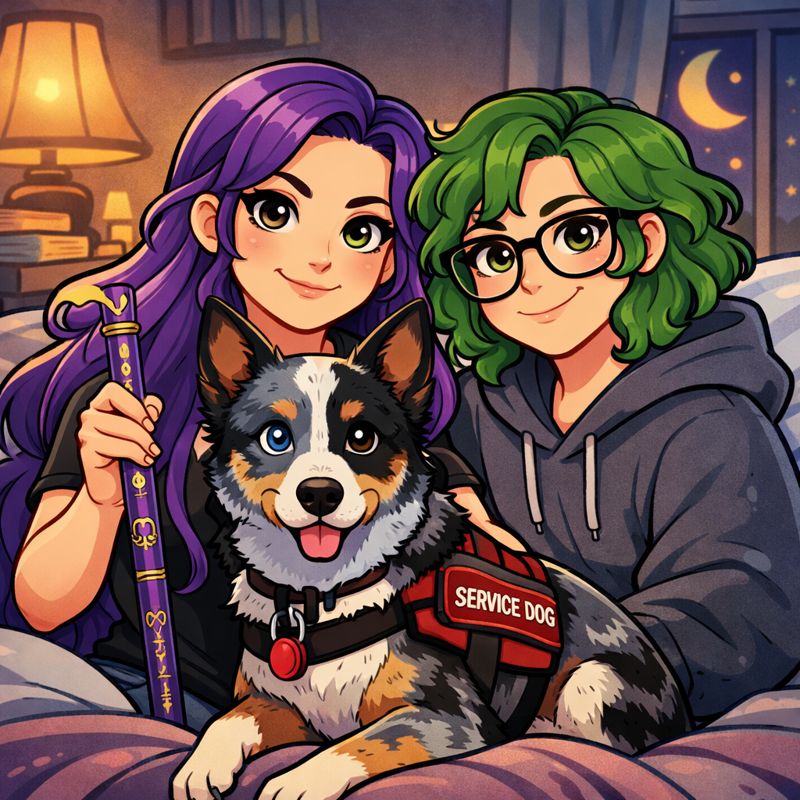
I live in a haunted meat suit with a deeply suspicious warranty. I spend a lot of time in Bed Jail™. I am almost never alone thanks to my medical alert service dog, Luna. She is part guardian, part shadow, part “excuse me, Mama. Sit your ass down. Right now.”
This space is about showing up for ourselves even when our bodies refuse to cooperate.
Chronic illness without inspiration porn.
Disability without apologies.
Love without pretending it’s easy.
Returning cryptids: welcome home.
New cryptids: pull up a chair.
Welcome to the Lunatic Café. The Den is big enough for all of us.
On today’s menu: Chronic Illness but Make It Honest.
Before we go any further, I need you to know three things.
1. I don’t lie to you.
I tell you what my life looks like as it’s happening. No jump cuts. No highlight reel. I don’t sugarcoat, and I don’t try to make this palatable.
Not because I want to shock you.
Not because I want to hurt anyone.
But because disabled lives are already watered down enough.
There were once “disappointment rooms” in attics and basements, where families hid disabled relatives so they wouldn’t have to look at us. Up until disturbingly recently in the United States, there were “ugly laws” that criminalized disabled bodies in public spaces.
You will be hearing a lot from me when it comes to the ugly laws, I just haven’t been ready… yet.
That history didn’t vanish. It just changed clothes. It shows up now as pity, as inspiration porn, as silence, as people deciding what parts of our lives are acceptable to witness.
This blog exists because I refuse to disappear quietly.
2. This is my life.
No matter what I do, I am disabled.
There is no remission for Ehlers-Danlos Syndrome.
No cure for POTS.
No tidy ending for CRPS, PKD, PCOS, MCAS, or the rest of my alphabet soup.
No amount of yoga, smelling salts, or essential oils can fix me.
These conditions are permanent residents. I didn’t invite them.
They unpacked anyway.
If I hadn’t had my DRG spinal cord stimulator removed, that would have been permanent too. Which means this is the body I live in. This is the nervous system I wake up with. This is the reality that follows me whether I’m graceful about it or not.
I am learning how to live with it.
Some days I do not like it.
Both things can be true.
And here’s the part that doesn’t get said enough: depression does not show up because I’m ungrateful, negative, or failing to cope. It shows up because living in a body that requires constant management is exhausting. Because pain, unpredictability, and loss stack over time. Because grief doesn’t always announce itself loudly.
Depression, in this context, is not a character flaw.
It’s a symptom.
A response.
A very human reaction to carrying too much for too long.
3. Coping doesn’t look the same for everyone.
Some people can build beautiful aesthetics around their illness. Soft lighting. Carefully edited joy. Inspirational captions that fit neatly into an algorithm.
Right now, I am not one of those people.
I just came off a six-day continuous heart monitor. The adhesive wrecked my skin. It hurt. It itched. It pulled. It overstayed its welcome. Nothing about it was cute, fun, or redeemable.
And when you live like that long enough, depression doesn’t arrive as a dramatic breakdown. It seeps in quietly. It sounds like “what’s the point?” It looks like emotional numbness. It feels like being tired in a way sleep doesn’t touch.
This blog is not about inspiration porn.
That phrase has become one of my least favorites in the English language, because it describes something disabled people are force-fed constantly. Especially young disabled people.
Strangers see a cane or a wheelchair and ask, “What happened to you?”
Then their voices soften.
They tilt their heads.
They turn you into a tragedy they can walk away from.
As if you don’t already know.
As if you haven’t been using mobility aids since your early twenties.
As if you haven’t been avoiding perfume since you were thirteen because MCAS will put you on the floor and send you into anaphylaxis.
This behavior isn’t random. It’s cultural. It’s learned. It’s baked into how society talks about bodies, worth, and productivity.
And that’s why representation matters.
From Bed Jail™, M&M and I have been watching shows that handle disability with something rare: respect.
See, where everyone is born without sight, and the sighted are the ones treated as strange. They aren’t saviors. They aren’t gods. They’re just people navigating a world not built for them. Not anymore, at least.
Invasion, where Caspar’s seizures don’t make him lesser. They give him access to something others can’t reach.
Silo, where people with “the Syndrome” are limited, monitored, and quietly segregated. Is it right? No. But it’s familiar. It mirrors how real systems decide who gets access and who gets sidelined.
Disability is not a metaphor.
It is not a lesson.
It is not a punishment or a gift.
It is a way of existing in a body the world was not designed to accommodate.
And sometimes, even with love, support, and a very good dog, it is heavy.
Before you keep reading or scroll to the end, this is your gentle reminder: you don’t have to finish this in one sitting. You can pause. You can close the tab. You can come back later. The words will wait for you.
And if you’re wondering whether joy still exists here, it does. Quietly. In flashes. In small, stubborn moments. But joy is not proof of worth, and suffering does not negate it. You don’t owe either to anyone.
If you know of shows or movies that portray disability with nuance and care, tell us. We notice. We remember. We share.
If today’s post was heavy, thank you for carrying it with me.
If you’re reading this from Bed Jail™, give your service dog an extra scritch for me.
Love you. Now say it back.
-Sky
© The Crippled Cryptid
Disability, honesty, and a little chaos.
If you’re here, you belong here.
🔗 https://linktr.ee/skylanarissa
There’s never pressure to donate. Reading, sharing, or simply staying is more than enough.
But if you’d like to support my ongoing journey toward health, stability, and mobility, you can do so here:
💜 https://www.gofundme.com/f/support-skys-journey-to-health-and-mobility


Leave a comment