Content Notes
This post discusses disability discrimination, historical ableism, seizures, medical gaslighting, falling injuries, and emotional distress following a medical event. Please take care of yourself while reading.
Welcome back to the Cryptid’s Den.
This is The Crippled Cryptid, a soft-lit corner of the internet where disability, chronic illness, service dogs, and everyday survival magic gather like familiar spirits who know when to sit quietly and when to laugh too loud.
If you’re new here: hi. I’m Sky.
Professional cryptid.
Unwilling amateur cyborg.
Medically interesting enough to make half my providers sigh when they open my chart. I sigh too.
More than anyone else, I’m tired of trying to explain my body and how it works to people.
I live in a haunted meat suit with a deeply suspicious warranty, spend a lot of time in Bed Jail™, and am almost never alone thanks to my medical alert service dog, Luna. She is part guardian, part shadow, part “excuse me, Mama, sit your ass down right now.”
This space is about showing up for ourselves even when our bodies refuse to cooperate.
Chronic illness without inspiration porn.
Disability without apologies.
Love without pretending it’s easy.
Returning cryptids: welcome home.
New cryptids: pull up a chair.
Welcome to the Lunatic Café. The Den is big enough for all of us.
On today’s menu: The Ugly Laws.
Without getting too punny, I need you to know this upfront: the United States has an ugly past. Not metaphorically. Legally. Structurally. On paper.
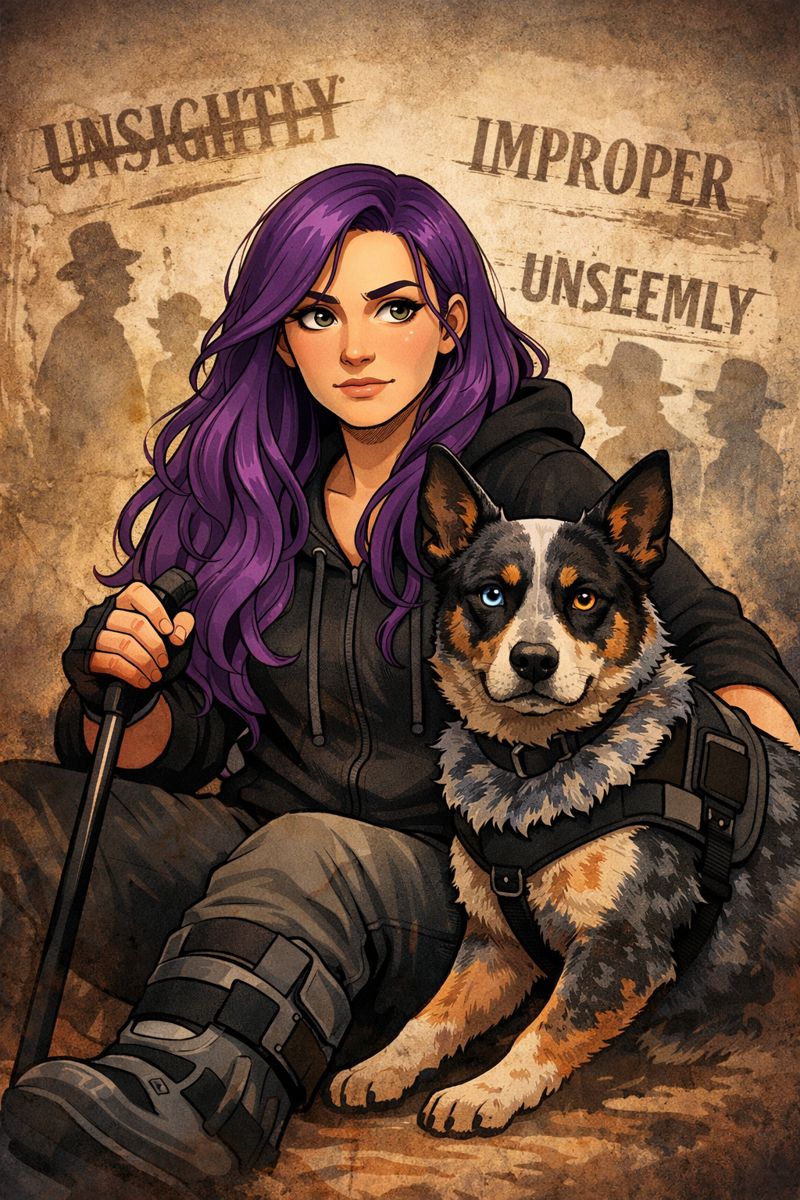
From 1867 to 1974, various cities across the U.S. enforced what were later called Ugly Laws or unsightly beggar ordinances. These laws made it illegal for people who were deemed “diseased,” “maimed,” “mutilated,” or “deformed” to appear in public.
Let that settle for a second.
In 1867, San Francisco declared that anyone who was considered an “unsightly or disgusting object” could not expose themselves to public view. Chicago followed in 1881. Portland. Omaha. Denver. Columbus. Entire states flirted with it.
Some succeeded.
The punishment was fines, jail time, forced institutionalization, or being sent to poorhouses and work farms. The crime was existing in public while disabled and poor.
The language mattered. It wasn’t about safety. It wasn’t about care. It was about visibility. About who was allowed to be seen.
Disability was framed as obstruction.
Poverty as contamination.
Disabled bodies as a public nuisance.
And if this sounds familiar, that’s because history rarely disappears.
It just learns new vocabulary.
Here’s why this matters to me.
My mother was born in 1976. Disabled. Poor for most of her life. Had these laws still been in effect, she would have been legally hidden.
I was born later, but not far enough away.
I live in Illinois. I’m 30 years old. I walk with a cane. Some days I need a walker. Some days I need a wheelchair. Since October, I’ve been walking in a fracture boot because I still have DRG spinal cord stimulator wires embedded in my body, which means I can’t have an MRI. Which means I don’t know how well my fractures are healing. Which means I still don’t have a definitive answer for the seizures that keep happening.
The reason I take Keppra twice a day. Every day. No matter the side-effects.
The reason I blacked out in my kitchen yesterday.
The reason I fell down the stairs.
And yet.
Yesterday, in my own home, after a seizure that didn’t look like television thinks seizures should look, I was told it was “just anxiety.”
That I held my breath.
That I did it to myself.
That I made myself dizzy and passed out.
This was said while I was on the floor.
Confused.
Terrified.
Asking for help.
Instead of getting my partner.
Instead of listening.
Instead of believing me.
I was narrated. Minimized. Corrected in real time while my body failed me.
Because the seizure wasn’t cinematic enough.
Because it wasn’t convulsive.
Because it didn’t match a stereotype.
Because the person standing over me was lucky enough to live in a body that doesn’t sometimes turn into a locked room with no exits.
Here is the part people don’t like to hear.
When you tell a disabled person that what they experienced wasn’t real, wasn’t serious, wasn’t medical, wasn’t worth responding to, you are not being rational or calm or helpful.
You are teaching them not to trust you.
You are teaching them not to trust themselves.
You are reinforcing the idea that their body is a problem best explained away.
That harm doesn’t end when the moment does.
I didn’t sleep last night. Not because of pain alone, but because those words kept looping.
“Just anxiety.”
“You did it to yourself.”
As if language has no consequences.
Even those who might be saying that they didn’t mean it that way- to you, I say this, intent does not erase harm. It doesn’t change the hours my partner and I laid in bed talking about it. It doesn’t change the throbbing in my head from hitting it on the floor the first time I fell, or when I fell down the stairs trying to escape their words coming again and again saying that it was “just anxiety” or that I was “doing this to myself” when he told it to my family. My support system.
Minimizing me, and my disabilities to them.
Following me down the stairs, after knowing I’d fallen down them. After my family got me to bed. Nothing you say will change what he did, or did not do.
The Ugly Laws were repealed by 1974. Chicago was the last holdout. On paper, they’re gone.
But their legacy lingers.
In how disabled people are doubted first.
In how we are treated as inconveniences.
In how our pain is interrogated instead of addressed.
In how we are expected to perform sickness correctly or not at all.
On TikTok, I watch people explore abandoned houses and find what they call disappointment rooms. Back bedrooms. Attics. Locked spaces where families hid the sick, the disabled, the inconvenient.
People like me.
The laws said we couldn’t exist in public. Society still flinches when we do.
And if they don’t flinch they infantilize us until we wish that we didn’t.
If someone tells you they don’t feel well, and you know they just finished a six-day continuous heart monitor, and they ask you to get their partner because they don’t have their service dog or their phone, you go get help.
You do not talk over them.
You do not narrate them.
You do not decide what is happening to their body because it makes you more comfortable.
That doesn’t make you a good person.
And it doesn’t make you a good friend.
And no, I don’t expect the person who did this to read this.
Here’s a free tip: narcissists don’t read things unless it flatters them.
This post isn’t for them.
It’s for every disabled person who has ever been told to make themselves smaller. Quieter. Less visible. Less inconvenient.
The Ugly Laws didn’t vanish.
They just stopped saying the quiet part out loud.
And I refuse to be quiet in return.
Love you. Now say it back.
-Sky
© The Crippled Cryptid
Disability, honesty, and a little chaos.
If you’re here, you belong here.
If today was heavy, thank you for carrying it with me.
If you’re reading from Bed Jail™, give your service dog an extra scritch for me.
🔗 https://linktr.ee/skylanarissa
There’s never pressure to donate. Reading, sharing, or simply staying is more than enough.
If you’d like to support my ongoing journey toward health, stability, and mobility:
💜 https://www.gofundme.com/f/support-skys-journey-to-health-and-mobility


Leave a comment