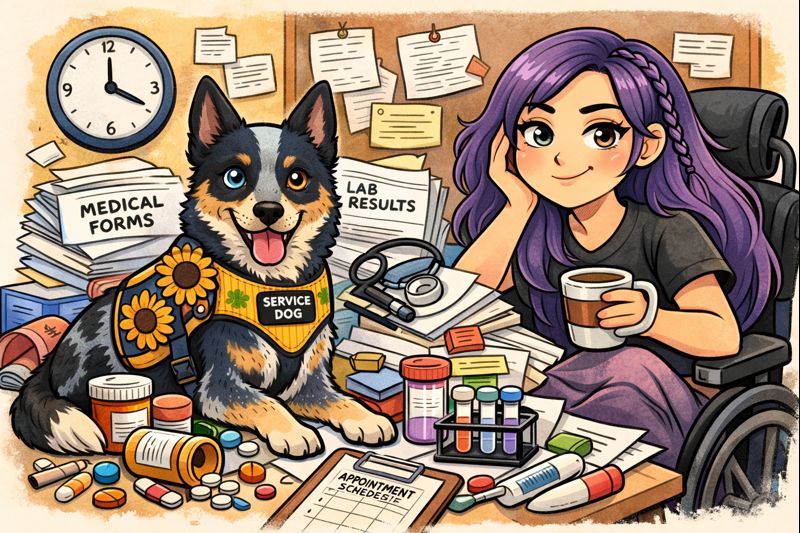
Content Note: This post discusses chronic illness, medical trauma, invasive procedures, blood draws, medical gaslighting, surgical complications, and diagnostic uncertainty.
Welcome Back to the Cryptid’s Den
Welcome back to The Crippled Cryptid, where disability, chronic illness, service dogs, and everyday sorcery gather under the same soft lamp like friendly ghosts trading survival tips.
If you’re new here: hi, I’m Sky.
Professional cryptid.
Unwilling amateur cyborg.
Medically interesting enough to make half my providers sigh when they open my chart. Honestly, I sigh too. Then I roll my eyes.
Sometimes, I wish I could roll over a few toes with my wheelchair. Purely hypothetically. For morale. Teambuilding even.
I live in a haunted meat suit with a highly questionable warranty that expired sometime around the Titanic sinking.
Returning readers, welcome home.
New cryptids, welcome to the Lunatic Café.
On today’s menu: Medical Appointments Are a Full-Time Job.
Some days I say that out of spite.
Some days, I mean it literally.
Today is one of those days.
Medical Appointments Are a Full-Time Job
There’s a special kind of exhaustion that only comes from medical appointments. Not just the appointment itself, but everything orbiting it like debris in low Earth orbit.
Scheduling.
Insurance calls.
Waiting on hold.
Waiting on hold again.
Unhelpful office staff.
Transportation, especially rideshare.
Forms.
The consult.
The aftermath.
And no, I don’t just mean the bruises left behind by someone who couldn’t hit a vein with a cannonball.
If someone told me this was optional, I’d laugh until I cried. Medical care for chronically ill and disabled people is a full-time job. One most of us would quit immediately if that were allowed. (M&M and Luna both say it isn’t.)
The invisible labor alone is staggering. Insurance negotiations, test results, paperwork, transportation logistics, post-appointment recovery. It all counts as work.
Some days, a single three-hour consult leaves me bedridden for the rest of the day. Sometimes for several days, if I let the post-appointment slump drag me under.
And yet, society treats medical appointments like a casual outing. A quick errand. A checkbox.
It isn’t.
Each appointment comes with new risks and higher stakes than the last.
The Hidden Costs No One Warns You About
New medications.
Every new prescription is a gamble. Side effects. Interactions. Contraindications. Some doctors warn you. Some don’t know. Some don’t bother.
One genuinely helpful thing for me has been keeping my medication list updated in Apple Health. It flags drug interactions as emergent, severe, or moderate. Because sometimes the only safety net is the one you build yourself.
New tests.
“Routine blood work” sounds harmless until you have veins made of wet tissue paper.
For me, blood draws are never simple. They require multiple nurses. No portable ultrasound. Reluctance to send me to the ER. Blown veins. Pain that lingers long after the needle is gone. We’re not even going to talk about bruises.
More bad news.
I’ve collected diagnoses like Pokémon cards. I do not want to catch them all.
Or worse:
“We don’t know why this is happening.”
Worse still:
“Your labs look great.”
Meanwhile, I’m passing out. I’m having seizures. My body attempts a factory reset over the smallest inconvenience, and no one has answers.
That kind of disconnect wears you down in places rest doesn’t reach.
Survival Guide for Appointment-Heavy Lives
This is not toxic positivity. This is field survival.
1. Schedule Strategically
Know your peak energy hours and protect them like a dragon guards gold.
Book long or difficult appointments when your body is most cooperative. If that’s not possible, try to arrange a ride with someone you trust. The last thing you need after a stressful appointment is an Uber driver who believes their minivan is auditioning for NASCAR.
2. Prepare Ahead (Because No One Else Will)
Forms. Questions. Symptom logs. Have them ready if you can.
If you can’t, keep your own records. Maintain a folder with your medical documents. Offices claim they share information. They don’t. They definitely don’t communicate well across different health networks.
I’ve gone back and forth with the same offices about whether or not I’m on the same medication because no one talks to each other.
Showing up prepared saves energy and sanity.
3. Protect Recovery Time
Leave buffers before and after appointments. Recovery is not optional. It’s part of the job.
If that means takeout, a Costco rotisserie chicken, boxed mac and cheese, or leftovers, so be it. Feeding yourself counts. Rest counts. Survival counts.
4. Track and Document Everything
Appointments. Results. Notes. Promises made.
This turns invisible labor into tangible proof. It also protects you when the system fails.
The DRG Saga (Why Receipts Matter)
For those who haven’t been following: I was supposed to have a full DRG extraction on March 11th, 2024. Wires. Battery. Everything removed.
It wasn’t.
I didn’t find out until November of 2025 that I was not MRI-safe. An MRI the same doctor had ordered. Then the seizures started in December 2025.
His office went back and forth with me about whether the DRG was fully removed. It took me and an incredible MRI tech advocating together to discover there were still leads embedded at L5-S1.
Medical waste. Abandoned inside my spine.
Now I need a laminectomy before I can ever have an MRI safely again.
This is why we keep notes.
This is why we document.
This is why we keep receipts.
Sometimes, the only person you can trust to have your back is you. Literally.
Closing
Medical appointments aren’t just part of life with chronic illness. They are life.
They deserve to be treated with the time, energy, and respect they consume.
And yes, it is absolutely okay to say they suck. Because they do.
They steal time. Moments you’d rather spend with people you love, doing things you love. Going to the zoo. A museum. Winnipeg. San Antonio. Anywhere but another waiting room.
Love you. Now say it back.
-Sky
© The Crippled Cryptid
Disability, honesty, and a little chaos.
If you’re here, you belong here.
If today was heavy, thank you for carrying it with me.
If you’re reading from Bed Jail™, give your service dog an extra scritch for me.
🔗 https://linktr.ee/skylanarissa
There’s never pressure to donate – reading, sharing, or simply staying is more than enough.
But if you’d like to support my ongoing journey toward health, stability, and mobility, you can do so here:
💜 https://www.gofundme.com/f/support-skys-journey-to-health-and-mobility


Leave a comment