(That No One Warned Me About)
Content Notes: chronic illness, disability, grief, mobility aids, service dogs, medical trauma, ableism (including intrusive comments from strangers), parental illness and loss.
No graphic medical detail.
Welcome back to the Cryptid’s Den.
This is The Crippled Cryptid.
A soft-lit corner of the internet where disability, chronic illness, service dogs, and everyday survival magic gather like familiar spirits who know when to sit quietly and when to laugh too loud.
If you’re new here: hi. I’m Sky.
Professional cryptid.
Unwilling amateur cyborg.
Medically interesting enough to make half my providers sigh when they open my chart. I sigh too. Often. Loudly.
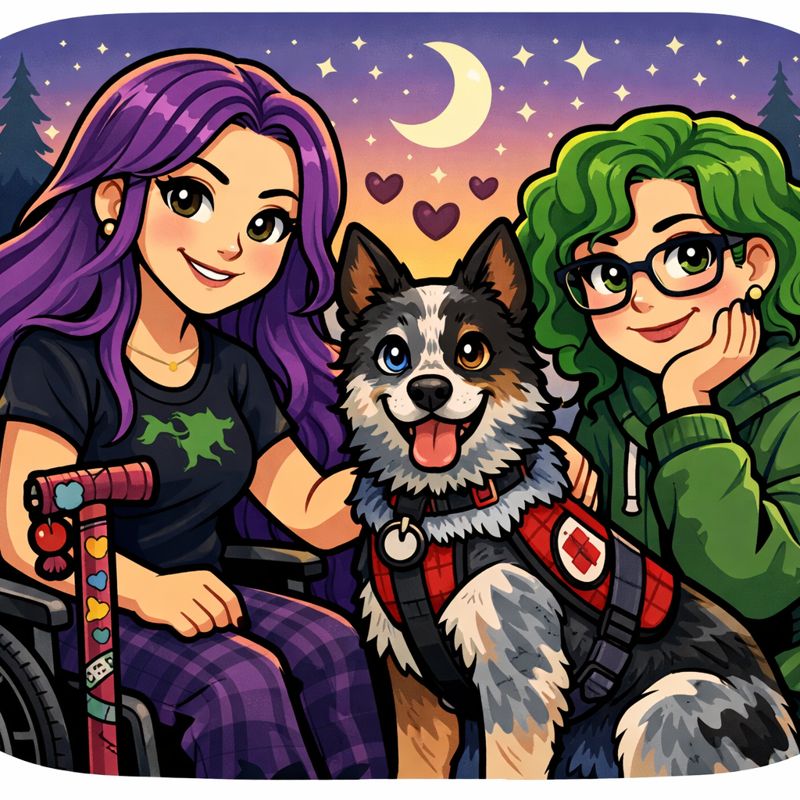
I live in a haunted meat suit with a deeply suspicious warranty. I spend a lot of time in Bed Jail™. I am almost never alone thanks to my medical alert service dog, Luna. She is part guardian, part shadow, part stern little voice that says, “Excuse me, Mama. Sit your ass down. Right now.”
And of course, M&M. She’s never far. Always there with the 90% when I only have 10 to give.
This space has always been about showing up for ourselves even when our bodies refuse to cooperate.
Chronic illness without inspiration porn.
Disability without apologies.
Love without pretending it’s always easy.
Returning cryptids: welcome home.
New cryptids: pull up a chair.
Welcome to the Lunatic Café. The Den is big enough for all of us.
On Today’s Menu: Things That Actually Made Living With Chronic Illness Easier (That No One Warned Me About)
No one hands you a welcome packet when you become disabled or chronically ill.
If they did, they either forgot to include me on the welcome wagon… or decided I already knew too much.
There’s no brochure that says: Here’s what will hurt. Here’s what will help. Here’s what will surprise you. Mostly, you get warnings. Dire ones.
About loss.
About limits.
About everything you won’t be able to do anymore.
You get the “I’m sorry” talks. The “cannot” talks.
The ones I hate. The ones where people talk to you like you’ve already died. Like adaptation isn’t something humans have been doing for thousands of years.
You know what I mean.
What no one talks about are the things that quietly make living in a chronically ill body easier.
Not magically better.
Not fixed.
Just… more livable.
Some of them look like losses at first.
Some arrive wrapped in grief.
Some feel like surrender until, one day, they don’t.
These are the things no one warned me about.
The things I hope I can talk you through if you’re at the start of your own journey.
And if you’re not at the beginning, if you’re somewhere in the messy middle or the tired later chapters, you’re not late. You’re still welcome at the table.
No one should have to walk this alone.
Mobility Aids Aren’t Giving Up. They’re Giving Back.
I was taught, subtly and relentlessly, that mobility aids were the last stop. A white flag. A visible admission that things had gotten bad.
This is learned behavior. And yes, I can trace it.
I don’t speak ill of the dead here, but my mother had cancer, and she rarely asked for help. She almost never brought her cane with her. Especially when she should have.
So, when I got hurt in 2020, shortly after she died, you can imagine who I thought I had to be.
I didn’t want the crutches.
I didn’t want the help.
(I also didn’t know yet that I had EDS, or why crutches were such a nightmare for my joints.)
In 2022, M&M and I walked into a thrift store and walked out with my first rollator. It was and still is lovely. Maroon red. Hard plastic seat. Hand brakes (the fact that they don’t work is irrelevant). A little bag underneath for my things.
It’s been very useful over the years.
Even if it hurt 27-year-old me’s pride.
30-year-old me is not so quick to judge.
Then 2024 brought my wheelchair.
It came from a free group, like so many of my things. Someone’s parent had passed away. The post said, Free to someone who may need it.
The goal, as I’m sure you know, was not to need it.
As it turns out, I do.
It’s a manual Drive chair. Strong wheels. All-terrain. Built to last. It came with a leather bag her dad used to keep snacks and keychains in. It was passed down from one snack gremlin to another, and I love that more than I can explain.
And that cane my mother didn’t use?
It’s mine now. Covered in stickers. A teddy bear hanging off of it. A pumpkin-shaped fidget popper. It goes everywhere with me.
Is this the life I wanted at 30? No.
But finding new stickers for my cane brings me joy. And more importantly, it genuinely helps me move through the world.
Mobility aids are not failures.
That is one piece of learned behavior I had to unlearn. Hard.
I’m still trying to unlearn it.
What no one told me is how much energy I was wasting pretending I didn’t need help.
A cane didn’t make me weaker.
It gave me stability.
It gave me the ability to leave the house without turning every step into a risk assessment.
It gave me a way to move with less pain and fewer apologies to my own body.
Mobility aids don’t shrink your world. They widen it.
They say: You deserve access. You deserve support. You deserve to get where you’re going.
And yes. People stare. People always stare.
But they stared anyway. At least now I can keep moving while they do.
And if you’re young and someone asks if you took your grandparent’s cane to play with (because yes, this has happened to me), remind them it has a wrist strap like a Wii remote.
You can shove it up their ass and get it back.
Disabled people are allowed to prioritize safety over politeness.
Is it the nicest thing to say to someone who is being a genuine asshole to you? No. But it will get them to go away. Sometimes, that is all that matters.
Service Dogs Change the Math Entirely.
Before Luna, every symptom carried a question mark.
Was this a migraine or just a headache?
Was my heart rate climbing or was I anxious?
Was it safe to push through, or would pushing cost me later?
Living like that is exhausting in a way that’s hard to explain unless you’ve done it.
A service dog doesn’t erase illness. But it shifts the balance of power.
Suddenly, I’m not guessing alone.
I have an early warning system with fur and opinions. Many opinions. We love her for it.
I have a partner who notices before I do. This doesn’t discount M&M. She noticed things too. But she couldn’t smell the physical changes in my body.
Because of Luna, I have time.
Time to sit down.
Time to take meds.
Time to adjust plans instead of crashing into a wall at full speed.
No one warned me how much peace that would bring.
Not cinematic freedom.
Just the quiet relief of not being the sole sentry guarding a fragile body.
Routines Become a Kind of Mercy.
I used to bristle at routines.
They felt boring. Restrictive. Like proof that spontaneity had been stolen from me.
Now I understand them differently.
Routines mean fewer decisions.
Fewer chances to forget meds.
Fewer moments where my brain has to work overtime to compensate for what my body is already demanding.
A routine is a soft rail to hold onto when everything else feels wobbly.
Morning meds.
Feeding Luna breakfast.
Checking in with my body instead of ignoring it.
Coffee. Always.
Sometimes a morning call with Aunt Lise. Sometimes a call with a doctor. Sometimes, we just exist and go from there. And that is okay.
Sometimes, that existing is done from Bed Jail™. Those days feel less okay but, those too are important.
These aren’t signs my life has gotten smaller. They’re signs I’ve learned how to care for myself without constant negotiation.
When your energy is limited, predictability becomes a gift.
The spoon theory matters here. A lot.
Grief Doesn’t Mean You’re Failing.
This one surprised me the most.
I thought once I accepted my diagnoses, the grief would fade. That acceptance was a finish line.
It isn’t.
Grief comes in waves. For old versions of myself. For plans that no longer make sense. For days when my body refuses to cooperate and I remember how easy things used to be.
But grief isn’t proof that I’m not coping.
It’s proof that I cared.
Letting myself grieve, without shame, made everything easier. Naming the loss instead of pretending it didn’t hurt. Holding space for two truths at once: I can be grateful for the life I have and mourn the one I thought I’d have.
Grief isn’t a setback. It’s part of the terrain.
You might see that grief here sometimes.
Sometimes it’s weddings I couldn’t attend because of my health and a car accident.
Sometimes it’s the Christmas market we couldn’t go to because of seizures, transportation, and everything else.
Sometimes it’s nothing specific at all.
You’re allowed to be sad.
You’re allowed to miss who you were.
Joy Shows Up in Smaller, Sturdier Ways.
No one tells you joy doesn’t disappear. It just changes scale.
It looks like a good pain day.
A meal that doesn’t trigger symptoms.
A quiet afternoon where my body and brain are briefly on the same page.
It looks like my service dog curled up beside me, her weight grounding me in the present.
It looks like finishing a book after months of not being able to read.
It looks like laughter that sneaks up on me.
Or a video call where M&M and I are laughing in the dining room, while BJ critiques an Epic brownie mix we’ve made together on camera for Aunt Lise. We’re all laughing, and having a great time. We got a 4.8 out of 5 stars, by the way, if anyone was wondering.
These joys aren’t loud.
They don’t announce themselves.
But they’re sturdy.
They last.
Letting Go of Who You “Should” Be Is the Biggest Ease of All.
Living with chronic illness became easier when I stopped measuring myself against a body I no longer had.
Or at least started trying to. (Because trying is half the battle.)
When I stopped treating accommodations like moral failures.
When I stopped apologizing for resting.
When I stopped believing productivity was the price of worth.
No one warned me that self-compassion would be one of the most effective tools I’d ever have.
Not curing.
Not fixing.
Just learning how to live here, in this body, as it is.
And that made things easier more than anything else.
And I know what you’re thinking, if you’re anything like me.
That this is hard.
That you’re young, and your friends are getting married, having babies, traveling, living lives… while you’re stuck in waiting rooms. Waiting for test results. Waiting for surgery dates. Waiting to see what happens next.
The waiting is the hardest part.
You’re probably thinking none of this is fair.
You’re right.
It isn’t.
You didn’t ask for this body. And now you’re being asked to live in it anyway. So we’re going to do that one step at a time.
Together.
Because no one should have to face this life alone.
Love you. Now say it back.
-Sky
© The Crippled Cryptid
Disability, honesty, and a little chaos.
If you’re here, you belong here.
If today was heavy, thank you for carrying it with me.
If you’re reading from Bed Jail™, give your service dog an extra scritch for me.
🔗 https://linktr.ee/skylanarissa
There’s never pressure to donate. Reading, sharing, or simply staying is more than enough.
But if you’d like to support my ongoing journey toward health, stability, and mobility, you can do so here:
💜 https://www.gofundme.com/f/support-skys-journey-to-health-and-mobility


Leave a comment