Welcome Back to the Cryptid’s Den
This is The Crippled Cryptid– a soft-lit corner of the internet where disability, chronic illness, service dogs, and everyday survival magic gather like familiar spirits who know when to sit quietly and when to laugh too loud.
If you’re new here: hi. I’m Sky.
Professional cryptid.
Unwilling amateur cyborg.
Medically interesting enough to make half my providers sigh when they open my chart. I sigh too. Then I roll my eyes and ask for snacks.
I live in a haunted meat suit with a deeply suspicious warranty, spend a lot of time in bed jail, and am almost never alone thanks to my medical alert service dog, Luna- part guardian, part shadow, part “excuse me, Mama. Sit your ass down, right now.”
This space is about showing up for ourselves even when our bodies refuse to cooperate.
It’s about chronic illness without inspiration porn.
Disability without apologies.
Love without pretending it’s easy.
Returning cryptids: welcome home.
New cryptids: pull up a chair. The Den is big enough for all of us.
On today’s menu:
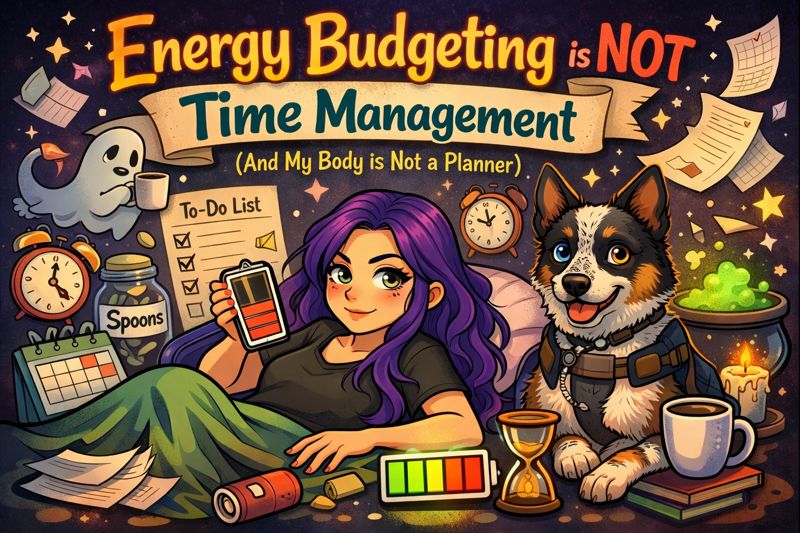
Energy Budgeting Is Not the Same as Time Management.
“Just Manage Your Time Better” (Sure, Jan)
You know that phrase, “just manage your time better”?
Yeah. That’s cute.
If someone handed me a magical planner that could untangle mysterious crashes, unpredictable pain, and brain fog, I’d frame it and hang it above my Bed Jail™. Spoiler alert: it doesn’t exist.
Because no matter how many lists I make or how carefully I promise myself I won’t overdo it, these three things remain aggressively true:
1. Burnout Happens. Even When You’re Careful.
There’s no battery icon floating above my head. No helpful percentage warning me that I’m about to hit critical levels.
I can go from 100% to 10% in an hour if I’m not careful. And sometimes, even when I am careful.
No amount of time management fixes a nervous system that crashes without warning. Trust me, I’ve tried.
2. Delegation Isn’t a Cure-All Either.
You’ll hear it a lot: delegate the big tasks.
Gardening. Yard work. Heavy lifting. The obvious stuff.
But here’s the thing. The people you delegate to are also human. They’re at work. They’re busy. They’re exhausted. Or they simply aren’t available when your body decides today is the day it’s staging a coup.
You can’t always rely on everyone to be on the same schedule. No matter how much that would simplify things.
3. Chronic Illness Does Not Care.
It doesn’t care how much sleep you got.
It doesn’t care if it’s Christmas, New Year’s, Thanksgiving, or Easter.
It cares about what it needs right now.
Sometimes that’s water.
Sometimes it’s eighteen hours of sleep.
There is rarely an in-between.
There’s no reliable warning system. No neat way to gauge when it’ll hit or whether today’s needs will be manageable.
It just… happens.
So, What Is Energy Budgeting?
Energy budgeting isn’t about squeezing every minute of your day into a color-coded schedule. It’s not about forcing productivity when your body is actively plotting mutiny.
Energy budgeting is about respecting your battery life. Your personal supply of spoons. Or, in cryptid terms, your limited pixels of vitality.
It’s knowing which tasks are monsters you can fight today, which are ghosts you’ll chase tomorrow, and which should be left alone entirely.
At least in theory.
The Lie I Still Tell Myself
If I’m being honest, there are still days where I pretend I’m able-bodied. Especially around the holidays. Especially when I have a picture in my head of what my loved ones “deserve.”
And especially when social media is loudly showing me people my age doing everything I wish I could do right now.
That’s usually when I have to stop and remind myself:
I’m a real person.
Social media isn’t.
Spoon Theory, Evolved
When I first learned about spoon theory, it was revolutionary. Finally, a language for invisible labor.
But living with multiple chronic conditions taught me it’s only a starting point.
Practical energy budgeting is a negotiation.
It’s asking questions like:
Do I have a half-spoon for social interaction today?
Or do I need that energy just to sit upright in bed for ten minutes?
Some days, the answer is nothing.
And even on the days we lie to ourselves and say that isn’t okay, I promise you:
It is.
The people who love you will forgive missed calls and canceled plans. They would rather you be safe than hurt yourself trying to show up.
A Field Guide From My Own Cryptid Lair
1. Identify Your Energy Vampires
Some tasks look small but drain everything.
Long emails.
Doctor’s office call-backs.
Grocery shopping without a plan.
Crowded spaces.
These deserve respect.
Schedule them when your energy is highest. Delegate them. Automate them. Or cancel them when possible.
If M&M would let me, I’d cancel doctor call-backs entirely. But apparently that’s “not an option,” even if I hate arguing about MRI approvals and symptoms I’d rather not be experiencing.
And don’t get me started on Instacart. They really need better shoppers. I am so tired of filing complaints about bad produce.
2. Prioritize Monster-Fighting Tasks
If you only have three spoons, choose battles that matter.
Eating.
Mental health.
Deadlines that genuinely can’t wait.
Everything else becomes a spectral task for tomorrow.
This is where I’m lucky. When the monsters are too big, I have M&M to tag-team them with me.
Find at least one being who stands in your corner.
A partner. A friend. Even a well-meaning service dog.
Although Luna is deeply unhelpful with doctor phone calls. She lacks thumbs. And doctors’ offices do not speak dog.
3. Build Rest Into the Plan (Not as Punishment)
Rest is not failure.
It’s a strategy. A ladder. A way back into your day without collapsing halfway through.
This is where I struggle the most.
I was raised to believe I should be able to do everything myself. So, when I’m in Bed Jail™ delegating tasks like dinner or dishes, and they don’t happen on my internal timeline, I start questioning everyone’s competence.
Is that fair? No.
Is it learned behavior? Absolutely.
Toxic? Most definitely.
Letting go of control is hard. But it’s something I’m still learning. Slowly. Unevenly. Humanly.
4. Track Your Patterns (When You Can)
Over time, your body leaves clues.
Peak hours. Crash points. Warning signs.
I keep a cryptid energy map in my notes app. Morning fog. Mid-afternoon slump. Knowing these patterns helps. When they cooperate.
Lately, Keppra has thrown my entire map into chaos. Sleep is unpredictable. I’m dizzy, nauseated, and often unsure what to do with myself.
I hope it changes. Even if I know it might not.
The Real Point
Energy budgeting isn’t about doing more.
It’s about staying alive, present, and sane.
Sometimes the bravest thing you can do is close the laptop, ignore the checklist, and watch the world move without you.
That doesn’t make you lazy.
It makes you smart.
Even if it makes you sad sometimes. Even if you mourn the plans you canceled and the life you thought you’d be living by now.
Energy budgeting is personal magic.
Time management is just a cursed potion sold at the grocery store.
Choose wisely.
Love you. Now say it back.
-Sky
© The Crippled Cryptid
Disability, honesty, and a little chaos.
If you’re here, you belong here.
If today was heavy, thank you for carrying it with me.
If you’re reading from Bed Jail™, give your service dog an extra scritch for me.
🔗 https://linktr.ee/skylanarissa
There’s never pressure to donate – reading, sharing, or simply staying is more than enough.
But if you’d like to support my ongoing journey toward health, stability, and mobility, you can do so here:
💜 https://www.gofundme.com/f/support-skys-journey-to-health-and-mobility


Leave a comment