Content Notes:
This post contains discussion of rare disease and chronic illness, medical trauma, invasive procedures, surgical complications, chronic pain, disability and mobility aids, medical gaslighting, and brief references to historical enslavement and systemic erasure.
Please take care of yourself while reading.
Welcome back to the Cryptid’s Den.
Come in.
You can set things down here. Sometimes, things are heavy. We understand.
This is The Crippled Cryptid.
A quiet corner of the internet where disabled lives are allowed to be complicated, unpretty, and yet still deeply loved.
I’m Sky.
Professional cryptid. Accidental cyborg.
Amateur medical, chronic illness, and disability advocate.
Someone who lives in a body that keeps collecting footnotes.
I live with rare diseases. Plural.
The kind that don’t behave, don’t resolve neatly, and don’t like being explained in a hurry.
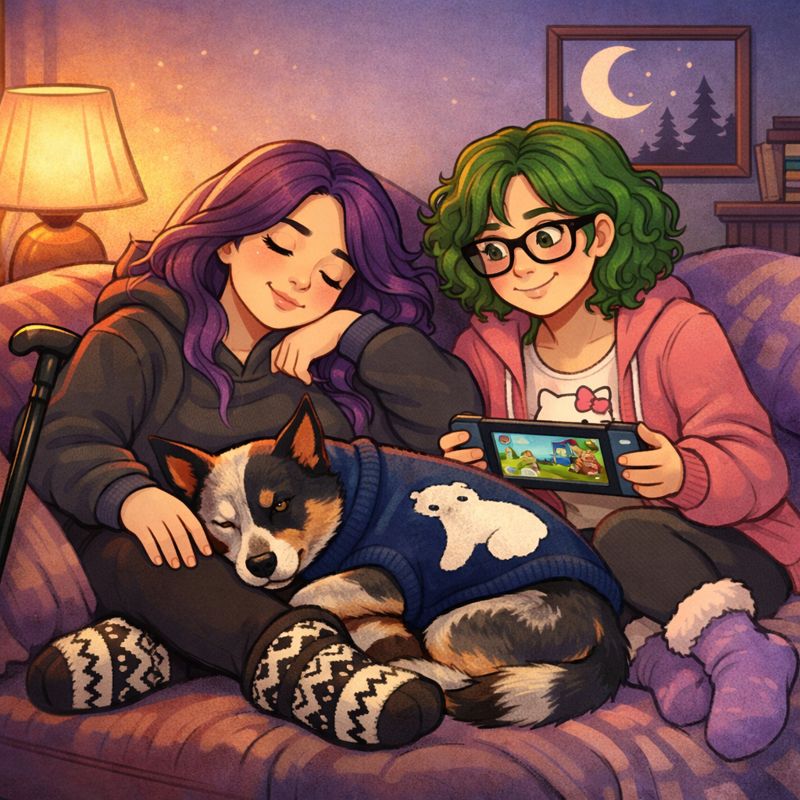
I also live with a service dog named Luna, who enforces rest with alarming efficiency and zero apologies. She is part guardian, part shadow, part “no, you’re actually not fine,” followed quickly by a harsher, “mumther, who the fuck told you that you could ignore me?”
Yes. I trained her to be a sassy girl.
Sometimes that’s what a stubborn ghoul like me needs.
Some days, I genuinely wonder if I did the right thing.
Some days, I wonder if I should be apologizing for it.
Some days, I just laugh.
M&M is my constant. My best friend. My player two.
The one who holds the world steady when my nervous system refuses to cooperate. Which is often.
This space exists for the days when survival is the whole task.
For telling the truth without turning it into a performance.
For naming what hurts without asking permission.
If you’ve been here before, I’m glad you came back.
If this is your first time, you’re welcome here.
The Lunatic Café is open.
On today’s menu: rare disease, medical aftermath, and the kind of visibility that doesn’t ask to be palatable.
February Holds More Than One Truth
February is Black History Month. That deserves to be named clearly and without caveat. It is a time that requires attention, amplification, and voices that are not mine.
I am not Black. I am not here to speak over or for a community I do not belong to. Black history, resistance, grief, and brilliance deserve to be centered by those who live it. If that is something you want to learn more about, I encourage you to seek out Black creators, historians, and educators who are already doing that work.
Lift them up.
Show them some love.
They deserve it.
There is a lot of history that still goes unlearned. We see it constantly.
The other night, M&M and I were scrolling TikTok and came across a video of a white girl, maybe late teens or early twenties, who did not know that cotton comes from a plant. That it has seeds. That enslaved people were forced to pick it. She did not know what a cotton gin was. She did not even know how to pronounce it.
Things I grew up learning in school in the 90s and early 2000s that they don’t teach in America today. I don’t think that’s right. And that’s coming from someone who lives in the United States. Someone who grew up here.
Everything about that was alarming.
It made me wish more people would engage with history intentionally. Watch films like Emancipation. Sit with discomfort. Learn how deeply systems of harm are woven into the present.
February can hold that truth.
February is also Rare Disease Month.
This post lives there.
Living as the Zebra
I exist at the intersection of diagnoses that most people only encounter as acronyms, if at all. I live every day with hypermobile Ehlers-Danlos syndrome, Postural Orthostatic Tachycardia Syndrome, and Mast Cell Activation Syndrome. Alongside those are fibromyalgia, Complex Regional Pain Syndrome, and seizures that still do not have a clean explanation.
That isn’t all of them.
Those are just the “rare” ones.
On any other day of the year, I’ll tell you I live with chronic illness alphabet soup. That there are more letters attached to my name than most doctors are comfortable with. That many of them don’t know what to do with me.
All of that is true.
I’ve had doctors ask me what Ehlers-Danlos syndrome is. I’ve watched them google it in front of me. I’ve heard it dismissed as a “TikTok disease.” I’ve been told POTS is just anxiety. Or laziness. Or a desire to avoid responsibility.
Rare does not always mean obscure.
Sometimes it means misunderstood.
Sometimes it means dismissed until it becomes unavoidable.
Sometimes it means becoming a case study in your own body.
I’ve lived long enough with chronic illness to know that awareness months are imperfect tools. They do not fix access. They do not guarantee belief. They do not stop doctors from shrugging or insurance companies from stalling.
They don’t stop insurance providers from telling you there are medications you “don’t need,” as if they were prescribed for fun. Ask me how I know.
But they do give language.
They give timing.
They give people like me a moment to say: this is real, and it is happening inside me.
Whether we like it or not.
Newsflash: we don’t.
We didn’t ask for this.
No one asked for this.
When Doctors Say “Horses”
There is a reason I trained a service dog instead of trying to muscle through this alone. Instead of waiting years on nonprofit lists that promise help someday, eventually, maybe.
If you’re wondering, I got on those lists in 2023. I still haven’t heard back.
That’s not to say service dog organizations don’t help people. They do. An enormous amount of time, energy, and money goes into training a service animal. But waiting years when you’ve already tried powering through, when you’ve already exhausted every other option, is not always viable.
It’s why I’m lucky Luna found us when she did.
Doctors love to say, “When you hear hoofbeats, think horses, not zebras.”
If you’re a fan of House M.D., you’ve heard it there too.
Unfortunately, I am the kind of patient you have to think zebras for.
My blood work never comes back normal. There are always markers off. Red blood cells out of range. White blood cells misbehaving. Numbers that suggest autoimmune disease somewhere, but never neatly enough to name it.
Everything feels like it’s on fire. All the time.
And yes, they’ve ruled out the basics.
I’m not diabetic.
I don’t have celiac.
I get blood work done so often that the labs know exactly where they can stick me and what they can stick me with. They know better than to ask me to go in dehydrated. They also know that if I don’t get the nurses I trust, I won’t allow the draw.
Portable ultrasound or no blood test.
Sure, I probably sound like a difficult patient.
But try going home and healing from eight blown veins and tell me you wouldn’t start putting rules on your body.
At this point, I ask for the meanest nurse on the floor. Every time. Not the young ones. Not the fresh, bright-eyed, ponytail nurses. No. Send me the one who’s been there since Moby Dick was a minnow.
The one they don’t want to see coming.
Those nurses know how to get a vein on the first try because they’ve been doing it since some of the newer doctors were in diapers.
If that’s what it takes to be in and out? I’ll take it.
I am tired of going home wrapped in ACE bandages like unlabeled clingwrap leftovers. My MCAS doesn’t tolerate adhesives. I don’t get bandages. I also don’t get the luxury of leaving with every vein in both arms blown out.
This is not drama.
This is logistics.
Luna, the Proof
Luna is not a Fab Four dog.
You’ve definitely heard me say that before.
She is an Australian Cattle Dog.
Built for stamina. Built for pressure. Built to notice when something is wrong and refuse to let it slide.
Was she meant to be a service dog? No. She came home as a pet. A companion for me and for our older dog, Bear, before he passed away.
Then she started alerting.
To migraines.
To autonomic shifts.
To things I hadn’t learned how to hear yet.
She chose her job. We just did the fine-tuning.
Luna mitigates my disabilities practically, not symbolically.
Interrupting. Alerting. Grounding. Creating pause where my body would otherwise spiral.
She is not a comfort animal.
She is an accommodation with teeth.
Before anyone gets their panties in a twist, no, she is not trained in protection or bite work. I am well aware those are non-negotiable no-go’s in the service dog community.
What I am saying is this: having Luna means I am taken more seriously.
In a world where many of my conditions are invisible, Luna is visible proof that my reality requires backup.
The kind that still isn’t guaranteed when M&M comes with me. Which is another problem entirely. You’d think bringing a partner or advocate would ensure you’re taken seriously.
Sometimes it does.
Often, it doesn’t.
I’m still learning how to live with that. Still learning how to speak up about it. Especially when I say no to a larger needle. When I warn someone they’re going to blow the vein. When I look away for one second and they do it anyway.
That’s exactly what happened during my failed PET scan on January 21st.
I’m writing this in February.
You can still see the bruise on my right arm very clearly.
Looking “Almost Fine”
I use a cane almost everywhere. It isn’t the best, but it isn’t the worst either. It’s a Hurrycane. It was my mother’s. She barely used it when she was alive.
When my disabilities did what disabilities do best and disabled me, I started using it.
I covered it in stickers. Added a pumpkin fidget popper. A teddy bear. Little things to make it mine.
People still look at me like I might be putting on a show.
I have a rollator when I can manage it. I also have a wheelchair, one I would use far more often if transportation and access weren’t constant barriers.
The wheelchair is heavy. Most Ubers aren’t big enough unless you pay for an XL or XXL. Even then, I couldn’t lift it in or out on my own.
From the outside, I look almost fine.
If you strip away the clothes, that’s when you see the scars. The discoloration on my leg from CRPS. The physical receipts.
The medical system wants me quieter. Simpler. Easier to categorize.
Luna refuses that.
The Hardware That Stayed
In 2021, I had a DRG spinal cord stimulator implanted to manage pain that had become unlivable. Before that, I endured more than five sympathetic nerve blocks that failed. Medications that failed. Including Lyrica.
In 2022, the device was revised. The battery malfunctioned. It burned me. The leads migrated.
In 2024, after a car accident rendered the device useless, it was supposed to be fully removed.
Bodies do not always follow plans.
In late 2025, we learned there are still leads retained at L5–S1. Pieces left behind. Now classified as abandoned medical waste.
Hardware that never quite left the building.
A quiet, physical metaphor for how rare disease works.
These retained leads now prevent me from getting the MRI I need.
Nothing is ever as finished as you are told it will be.
There is always another appointment.
Another imaging study.
Another sentence that begins with, “We didn’t expect this.”
Another halfhearted apology. Another referral. Another wait to be cut open again. As if the first two times, plus healing, weren’t bad enough.
Living with rare disease is learning how to exist there.
Still Here
I am not writing this to compete for attention.
Pain is not a finite resource.
Visibility is not a zero-sum game.
I am writing this because Rare Disease Month matters to me. Because these diagnoses shape every part of my life. Because my body has been altered, opened, revised, and still keeps going.
Because silence has never protected me.
February can hold more than one truth.
So can a body.
So can a story.
This one is mine.
If today was heavy, you didn’t carry it alone.
If today stirred recognition, I hope it felt grounding instead of isolating.
If today named something you’ve been living with quietly, I see you.
Rare does not mean invisible.
Complicated does not mean broken.
And surviving this long counts for more than anyone ever taught us to believe.
If you’re here, you belong here.
The door stays open.
Love you. Now say it back.
-Sky
© The Crippled Cryptid
Disability, honesty, and a little chaos.
🔗 https://linktr.ee/skylanarissa
There’s never pressure to donate. Staying counts.
If you’d like to support the long road toward stability and mobility:
💜 https://www.gofundme.com/f/support-skys-journey-to-health-and-mobility


Leave a comment