Welcome back to the Den.
This is The Crippled Cryptid.
It’s Folklore Wednesday.
The lights are lower than usual.
The air is listening.
This is the day we loosen the knots and let the old stories stretch their limbs.
On Folklore Wednesdays, we talk about the things that learned our names before we learned theirs.
French spirits and English ghosts.
Indigenous stories that remember the land better than maps ever did.
Old gods. New monsters. Familiar shapes wearing unfamiliar faces.
This is the day of hedge magic and hearth magic.
Of charms whispered into sleeves.
Of creatures that don’t wait for nightfall and spirits that have never respected bedtime.
Some of what lives here bumps in the dark.
Some of it walks openly in daylight, unbothered, unafraid, and very aware of itself.
You don’t need to believe.
You just need to be respectful.
You just need to listen.
You just need to be willing to leave things as you found them.
Pull your chair closer.
Folklore is a living thing.
And today, it’s awake.
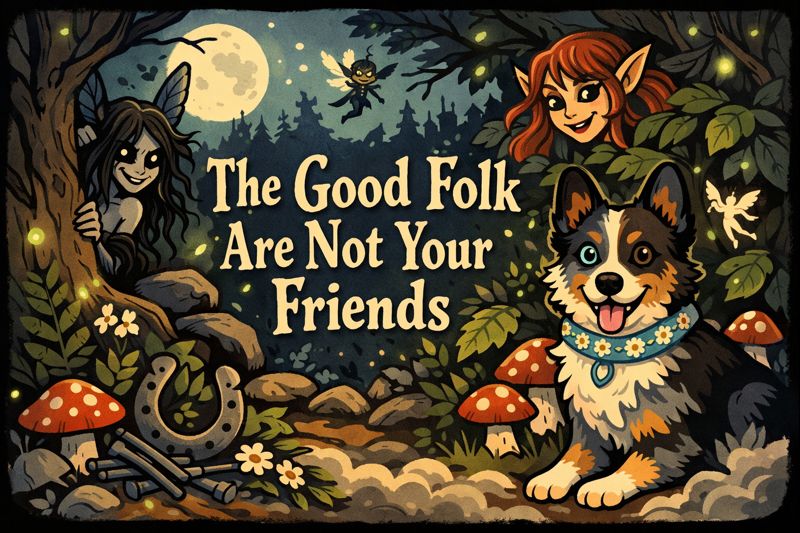
On Today’s Menu: The Good Folk Are Not Your Friends
Content Notes:
Discussions of folklore and otherness, historical superstition, parallels to ableism and chronic illness, unsettling imagery, and traditional warnings about Fae behavior.
I know some of you might be squinting at this title, wondering if you missed a chapter somewhere. After all, one of my earliest Folklore Wednesdays covered this exact idea.
The Fae.
The Good Folk.
The Fair Ones.
The Good Neighbors.
Aren’t they supposed to be sweet? Sparkly? Born the first time a child laughs?
That’s the version we inherited through Disney. Pixie dust, a little mischief and pastel wings.
What we didn’t inherit were the warnings.
Black eyes.
Inhuman reactions.
Emotions that don’t line up with ours because they were never meant to.
Things that were not human.
Things that will never be human.
And I think that disconnect matters.
There was a time when people believed the chronically ill were changelings. Not because it was true, but because fear fills gaps where understanding fails. We were labeled other. Not quite right. Not belonging fully to this world. Our bodies behaved differently. Our reactions didn’t make sense to the able-bodied gaze. So, folklore stepped in where compassion and knowledge did not.
Different became dangerous.
Different became not ours.
We’ll come back to that history later this month, gently and on our own terms. It’s something I’m excited to talk about and explore.
March, traditionally drenched in shamrocks and softened stories of Ireland, feels like the right time to talk about this honestly. March has always been a threshold month, a time when the rules loosen just enough for old things to step closer.
Not the sanitized version.
The real one.
Throughout this month, Folklore Wednesday is going to linger with the Fae. Who they are. How they differ from us. How humans were taught to behave around them. How to avoid offense. And why those rules existed in the first place.
Because folklore isn’t just fantasy.
It’s survival memory.
The Sidhe are not whimsical cottagecore neighbors borrowing sugar. They are ancient, clever, territorial, and utterly uninterested in human comfort. Irish folklore is littered with cautions: mind your words, respect boundaries, don’t assume kindness just because something is beautiful.
And that’s the lesson modern retellings sometimes forget.
The Good Folk were mirrors of a world where danger lived in the hedgerows and forests. Where consent mattered. Where intuition kept you alive. Where rules weren’t about politeness but protection.
Beauty was never proof of safety.
Survival Tips for Dealing With the Fae
- The Fae cannot lie. Their truths are twisted, indirect, and precise, but never false. Listen carefully.
- Red is dangerous. In many traditions, the color red can anger or repel the Fae depending on the type.
- Iron is your friend. Keep a piece of iron nearby; it wards off many Fae creatures.
- Do not accept gifts or food lightly. Anything given may bind you, trick you, or trap you.
- Do not underestimate words. Contracts, promises, and oaths are sacred to them.
- Do not assume kindness. They may smile, laugh, or play, but their amusement is never human amusement.
- Leave offerings. Small offerings of bread, milk, or shiny trinkets in traditional places can keep minor mischief at bay. Offerings are gestures, not invitations.
- Watch your speech and manners. Mockery, boasting, or disrespect can follow you home in ways you won’t see.
Every rule around the Fae is, at its core, a lesson about consent.
And before anyone starts sharpening their BookTok knives, no, this isn’t an attack on modern adaptations. I’ve read ACOTAR. I love Holly Black. Laurell K. Hamilton’s Merry Gentry series lives rent-free in my heart. Always.
But I will say this, loudly and often:
You need to know the past.
Where these stories come from matters.
Think of folklore as a manual.
Know the rules.
Honor the space.
Survive.
Sometimes, that’s the real magic.
This is the first warning.
Not the last.
The Closing of the Circle
That’s where we’ll leave the circle open for now.
If something followed you out of this story, you’re not in trouble.
Folklore has always liked company.
If something here felt familiar, trust that.
Old stories recognize their own.
Folklore Wednesdays are about remembering. About honoring what survived being passed mouth to mouth, fire to fire, body to body.
Thank you for sitting in the magic with me.
For listening instead of demanding proof.
For letting the strange things exist without taming them.
Until next time, keep a light on if you need it.
Or don’t.
Some of us see just fine in the dark.
Love you. Now say it back.
-Sky
© The Crippled Cryptid
Disability, folklore, and survival magic.
(And always a little bit of dog fur for morale.)
🔗 https://linktr.ee/skylanarissa
No pressure to donate. Staying, reading, sharing is already an offering.
If you want to support the long, slow work of staying alive and telling the truth:
💜 https://www.gofundme.com/f/support-skys-journey-to-health-and-mobility


Leave a comment